What is the difference between kW and kVA? Understanding units of electrical power
Publié le 13 March 2026
In the field of energy, and more specifically when discussing generators or mobile power systems, two units frequently come up: kVA (kilovolt-ampere) and kW (kilowatt).
These two concepts are often confused, yet they play a key role in sizing a generator. Understanding the difference between kVA and kW helps prevent sizing errors, improves energy efficiency, and ensures reliable operation of equipment.
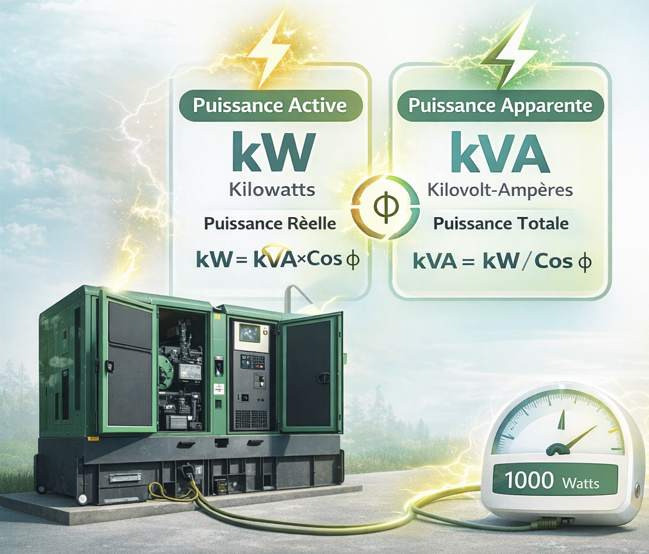
What is the difference between kVA and kW?

The kilowatt (kW) corresponds to real power, i.e., the energy actually used by electrical equipment to operate. This is the power that allows machines, tools, or lighting systems to function.
The kilovolt-ampere (kVA) represents apparent power. It is the total power supplied by a source, including both useful power and losses due to the electrical system’s operation.
In simpler terms:
- kW: power actually consumed by the equipment
- kVA: total power supplied by the generator
This distinction is important because a generator must always be able to supply more apparent power than the real power used.
The role of the power factor

The relationship between kVA and kW depends on a parameter called the power factor.
The power factor measures how efficiently electrical energy is used in a system. Its value ranges from 0 to 1. The closer it is to 1, the more efficiently the energy is used.
In most industrial installations or construction sites, a power factor of 0.8 is commonly used.
The relationship between the two units is therefore:
kW = kVA × power factor
Simple example
Let’s take a 100 kVA generator with a 0.8 power factor:
100 × 0.8 = 80 kW
This means the generator can deliver 80 kW of usable real power.
Why are generators rated in kVA?
Generator manufacturers generally use kVA to indicate the power of their equipment.
The reason is simple: a generator must handle not only the useful power but also electrical variations caused by loads, especially those from motors or certain industrial equipment.
Expressing power in kVA ensures that the generator can absorb load variations and operate without overload.
This is particularly important in environments such as:
- construction sites
- industrial facilities
- temporary events
- telecom infrastructures
- mobile energy systems
How to choose the right generator size?
Choosing a generator is not just about adding up equipment power. Several factors must be considered to avoid surprises.
1. Calculate total equipment power
First, add up the power of all equipment to be supplied, expressed in kW.
2. Consider starting power requirements
Some equipment, especially electric motors, require much higher power at startup.
3. Include the power factor
An installation with a low power factor will need more kVA to deliver the same useful power.
4. Allow a safety margin
It is generally recommended to provide 10–20% additional power to anticipate load changes or consumption peaks.
Concrete example on a construction site
Consider a site with the following equipment:
- compressor: 30 kW
- lighting: 10 kW
- power tools: 15 kW
Total power is therefore 55 kW.
With a 0.8 power factor, the required apparent power is:
55 / 0.8 = 68.75 kVA
In this case, it is preferable to use a generator of around 70 kVA to ensure stable operation.
The importance of proper sizing
An incorrectly sized generator can cause several problems:
- excess fuel consumption
- premature equipment wear
- power outages or instability
- reduced overall performance
Conversely, a correctly sized generator provides:
- better energy efficiency
- lower operating costs
- greater system reliability
These considerations are even more critical today with the rise of hybrid and intelligent energy solutions, capable of automatically optimizing energy production and consumption.
Conclusion
The distinction between kVA and kW is essential for correctly sizing a generator.
In summary:
- kW corresponds to the actual power used
- kVA represents the total power supplied by the system
Mastering this difference allows you to choose the right equipment, optimize energy performance, and ensure reliable installations.
In a context where mobile energy needs are rapidly evolving (more demanding sites, energy transition, emission reductions, and operating cost optimization), it is essential to rely on smarter, more efficient, and properly sized energy solutions.
At Ekonity, we assist professionals in sizing and optimizing their mobile energy solutions, integrating new hybrid technologies that reduce fuel consumption, emissions, and noise.
If you want to properly size a generator, optimize your energy setup, or explore a more efficient solution, our team can help analyze your needs.
Contact Ekonity to discuss your project and find the energy solution best suited to your activity.