Optimal sizing of generator sets
Publié le 6 March 2026
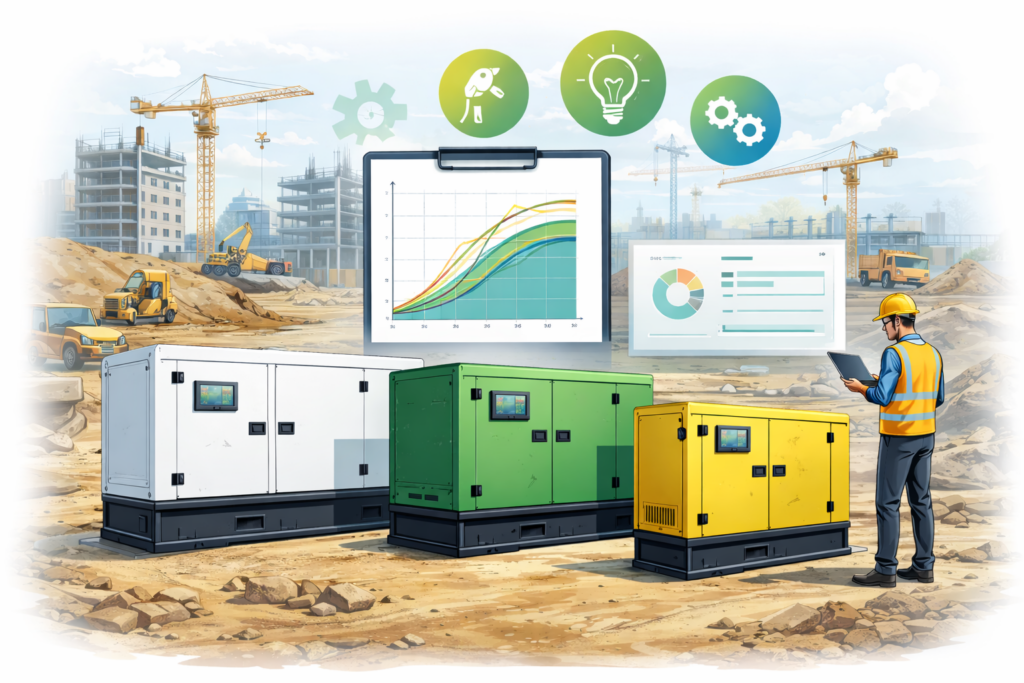
The EKONITY guide to choosing the right energy solution for your constraints
The optimal sizing of generator sets is a key step in ensuring the reliability, profitability, and environmental compliance of a construction site, industrial facility, or temporary event.
Today, this approach goes far beyond simply selecting a power rating in kW or kVA. It now includes a hybrid approach, combining a thermal engine, batteries, and sometimes solar energy, in order to optimize energy production according to real operational constraints.
Why optimal sizing is essential
A poorly sized generator set can lead to significant costs and reduce the lifespan of equipment.
❌Undersizing
- Risk of power outages
- Overheating
- Electrical instability
- Premature equipment degradation
❌Oversizing
- Higher investment cost
- Poor efficiency at low load
- Engine fouling
- Excessive fuel consumption
✅Optimal sizing
- Operation within the ideal efficiency range
- Controlled fuel consumption
- Reduced maintenance
- Optimized Total Cost of Ownership (TCO)
Proper sizing is based on an accurate analysis of the real energy demand profile.
Key steps in optimal generator sizing
1. Identify the loads to be powered
List all equipment: construction machinery, compressors, pumps, lighting, temporary installations, and IT systems. Record the rated power (W or kW) and distinguish between continuous and intermittent loads.
2. Consider starting power requirements
Electric motors may require up to 2 to 7 times their rated power during start-up. These peaks must be included in the calculation.
3. Calculate the total required power
Add together the continuous load, the probable simultaneous peaks, and include a safety margin of 15 to 25% to anticipate future developments.
4. Analyze the real load profile
Most sites do not operate at full power continuously. Analyzing daily variations, low-load periods, intermittent cycles, and night-time requirements helps optimize the energy solution.
5. Integrate operational constraints
Optimal sizing must consider noise constraints in urban environments, environmental regulations, fuel costs and logistics, autonomy requirements, and ESG objectives.
All these factors directly influence the energy configuration to be implemented.
Hybridization: a response to operational constraints
The hybrid approach combines an optimized thermal generator, a lithium battery system, possibly solar generation, and intelligent energy management.
Advantages of hybridization
- Absorption of power peaks thanks to batteries
- Reduced noise pollution by limiting engine operating hours
- Lower fuel consumption
- Reduced CO₂ emissions
- Lower maintenance costs
Hybridization often allows the installed thermal power to be reduced, as batteries absorb fluctuations and cover low-load phases.
Thermal or hybrid generator: how to decide?
| Situation | Recommended solution |
|---|---|
| Continuous operation at full load | Optimized thermal generator |
| Variable load with long idle periods | Hybrid solution |
| Urban construction site with noise constraints | Hybrid strongly recommended |
| Remote site with complex fuel logistics | Hybrid with reinforced storage |
| Carbon footprint reduction objective | Hybridization prioritized |
The choice results from a complete technical and economic analysis.
Mistakes to avoid
- Oversizing “for safety”
- Ignoring load cycles
- Basing the choice only on maximum power
- Ignoring regulatory constraints
- Neglecting total operating cost analysis
- Choosing based solely on purchase price
Optimal sizing must integrate a global vision: technical, economic, and environmental.
Towards a new approach to energy sizing
Generator sizing is no longer limited to installing the maximum possible power. It now requires a comprehensive analysis of the site’s real needs, operational constraints, and energy consumption profile.
This is precisely the approach developed by Ekonity. Through the hybridization of energy sources and intelligent management, Ekonity solutions adjust production as closely as possible to demand. This significantly reduces fuel consumption, operating costs, noise pollution, and environmental impact, while improving overall system performance.
With Ekonity, the generator becomes an intelligent, flexible, and sustainable energy solution designed to meet the current requirements of construction sites, industry, and events.
Would you like to see how Ekonity can address your operational constraints?
Connect with our team today and discover the solutions tailored to your projects.